For commercial general contractors, home builders and exterior remodelers
Build your look-ahead on days you'll actually work.
Pours, framing, truss sets, masonry and dry-in checked day by day for each project, with odds from up to 146 forecast runs.
The costly call
Every lost day stretches field overhead
When a pour gets called off at 6 am or a framing sub stands down for wind, the super, the trailer, the equipment and the schedule keep running. Every weather day you didn't plan for stretches the project's general conditions, and the owner still expects the dry-in date.
10%
general conditions as the most typical allowance of total cost (range 5–15%)
How it works
From your place to an answer
Add your project address
Each project gets its own forecast for its grid cell.
Pick your trades and set their limits
Choose the trades on your look-ahead and set the limits each one works to: gusts for the truss set, protection hours for the pour.
See which days each trade works
See how sure each day is, and move subs before they show up.
In the app
See it on a real forecast
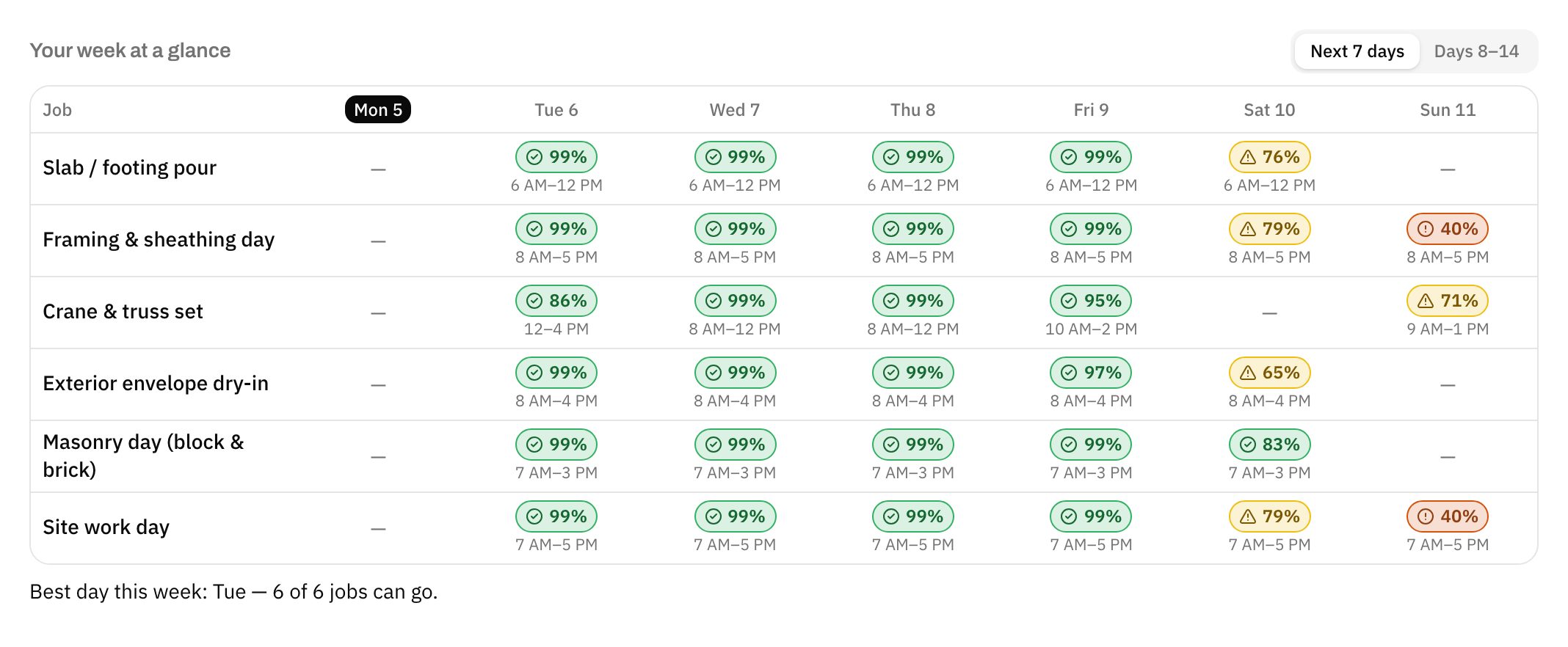
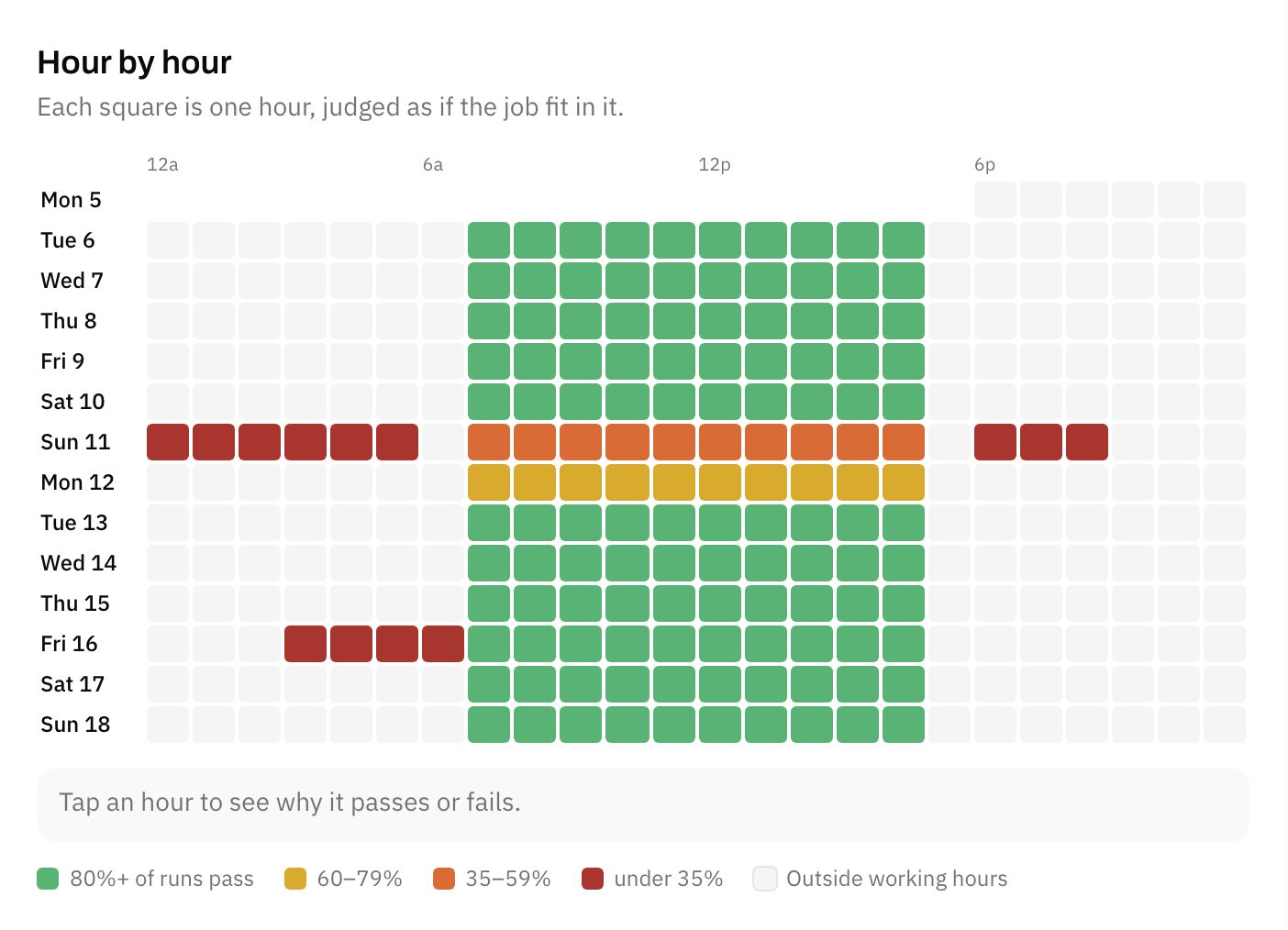
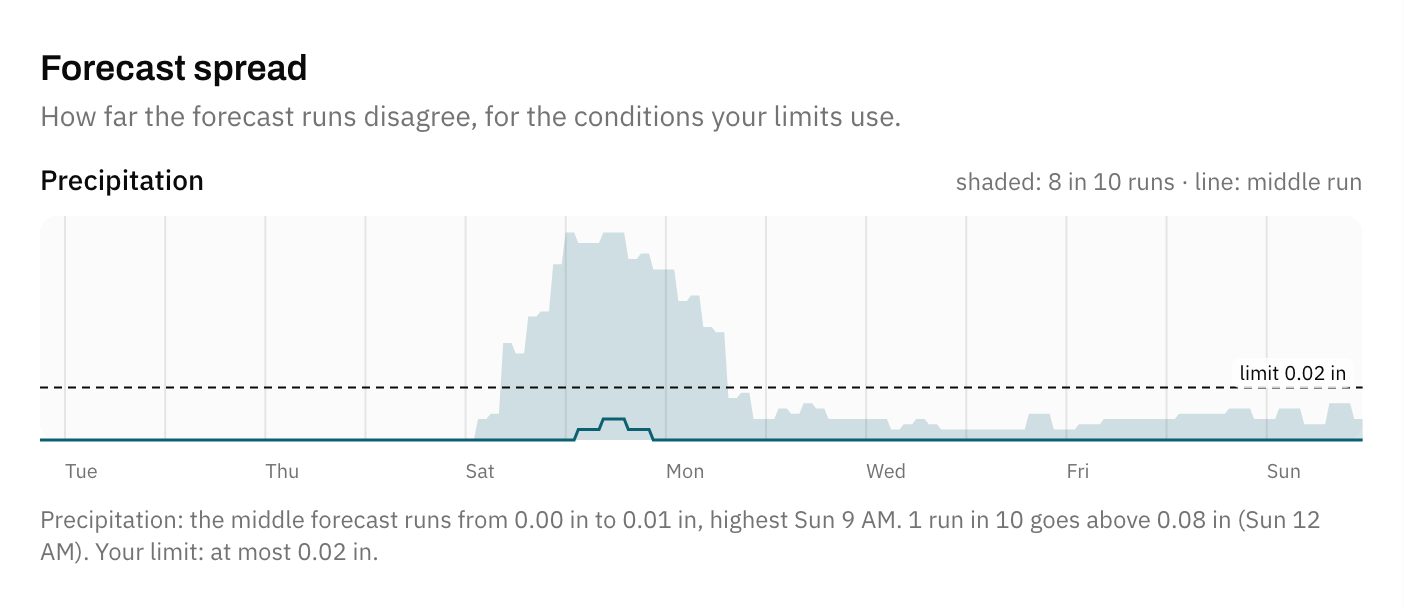
Real forecasts for Charlotte, North Carolina Piedmont, captured October 5, 2026. Yours will be for your own place and limits.
What you get
Built for commercial general contractors, home builders and exterior remodelers
Look-ahead risk
14 days per trade: which days the trade loses to rain, cold or wind, and how many workable days to expect this week and next.
Pour protection
The pour day most likely to keep the slab above 40 °F through your protection period (48 h to start; set your own), with the evaporation peak while you finish.
Crane & truss wind window
The best day and hour to set trusses this week against your gust limit and 30 mph at crane height.
Weather-day tally
Weather days on the project in the last two weeks, counted with half days and recovery days, as a draft for your daily log.
Masonry cold check
Block and brick days above 40 °F with 24 h at 40 °F or above after the last course.
Dry-in window
Dry, calm days for wrap, windows and roof underlayment, with dry hours after so the envelope stays dry.
The tasks it times
Slab / footing pour
Place and finish, then protect. Air stays at 40 °F or above through 48 h of protection; the 48 h length is a starting point — set your own.
6-hour window
Framing & sheathing day
Walls up, deck and roof sheathing.
9-hour window · daylight only
Crane & truss set
Set trusses, joists or panels with a crane. If anyone rides a platform, OSHA 29 CFR 1926.1431(k)(8)(i) requires a qualified-person determination when wind exceeds 20 mph.
4-hour window · daylight only
Exterior envelope dry-in
Wrap, windows, roof underlayment.
8-hour window · daylight only
Masonry day (block & brick)
Lay units without cold protection: air above 40 °F while laying and at 40 °F or above for the 24 h after.
8-hour window
Site work day
Grading, footing excavation, underground. Not the day after 1 in or more of rain.
10-hour window
What else it watches
- Look-ahead risk
- Pour protection
- Crane & truss wind window
- Weather-day tally
- Rain on the project
- Freeze on fresh work risk
- Wind at crane height
- Two dry days for dry-in
Every answer counts the forecast runs that keep the whole task inside your limits, at your project.
Founding members
Join the beta — your first six months free
Only 10 founding places: the first 10 commercial general contractors, home builders and exterior remodelers to apply get the Builders edition free for six months when it launches. No card needed. When they're gone, it's the waitlist.
Only 10 founding places.
- Your first six months of the Builders edition free when it launches
- Early access to the app as it is today
- A say in which tasks the Builders edition times next
Questions
Asked before you start
How is this different from a weather app?
It checks every hour of each task against your trade's limits in up to 146 forecast runs and gives the share that pass, not one forecast and a rain percentage.
Can I keep a record of my weather calls?
Yes. Log a window and the decision log keeps the verdict, the share of forecast runs that passed and the conditions the forecast showed, with your note. Export it to CSV for your daily log.
Does it replace Procore or my scheduler?
No. Use it to decide which days go on the schedule.
What data does it use?
Forecasts for your project's grid cell: an hourly forecast plus up to 146 forecast runs from three independent forecast systems, pooled and judged run by run, 14 days ahead and refreshed through the day.
Where do the limits come from?
Each one names its source (ACI, OSHA, CDOT specs, PMA); limits with no published number say "starting point" and are yours to set.
What can't it tell me?
It does not know your concrete temperature, mix, admixtures or blankets, so pour checks assume concrete at air temperature. Gusts at crane height are not forecast; 80 m wind is sustained only. There is no lightning or radar, so it cannot call a storm cell an hour out.