For roofing, exterior painting, siding and sealcoating/striping contractors
Start the tear-off on a day it stays dry.
Tear-offs, shingles, paint, stain, sealcoat and striping checked hour by hour for each job, with odds from up to 146 forecast runs.
The costly call
A wrong call is a callback on your dime
An open roof in a shower, paint that blushes under evening dew, or sealcoat washed off the lot means going back to the homeowner and doing the job again at your own cost.
How it works
From your place to an answer
Add the job address
Type the address of the house, building or lot. Each job gets its own forecast.
Pick the work
Tear-off, shingles, paint coat, stain, sealcoat or striping, each with its own limits.
See the best start
The best start for the crew, the odds it holds and what will stop it: rain, cold, wind or dew.
In the app
See it on a real forecast
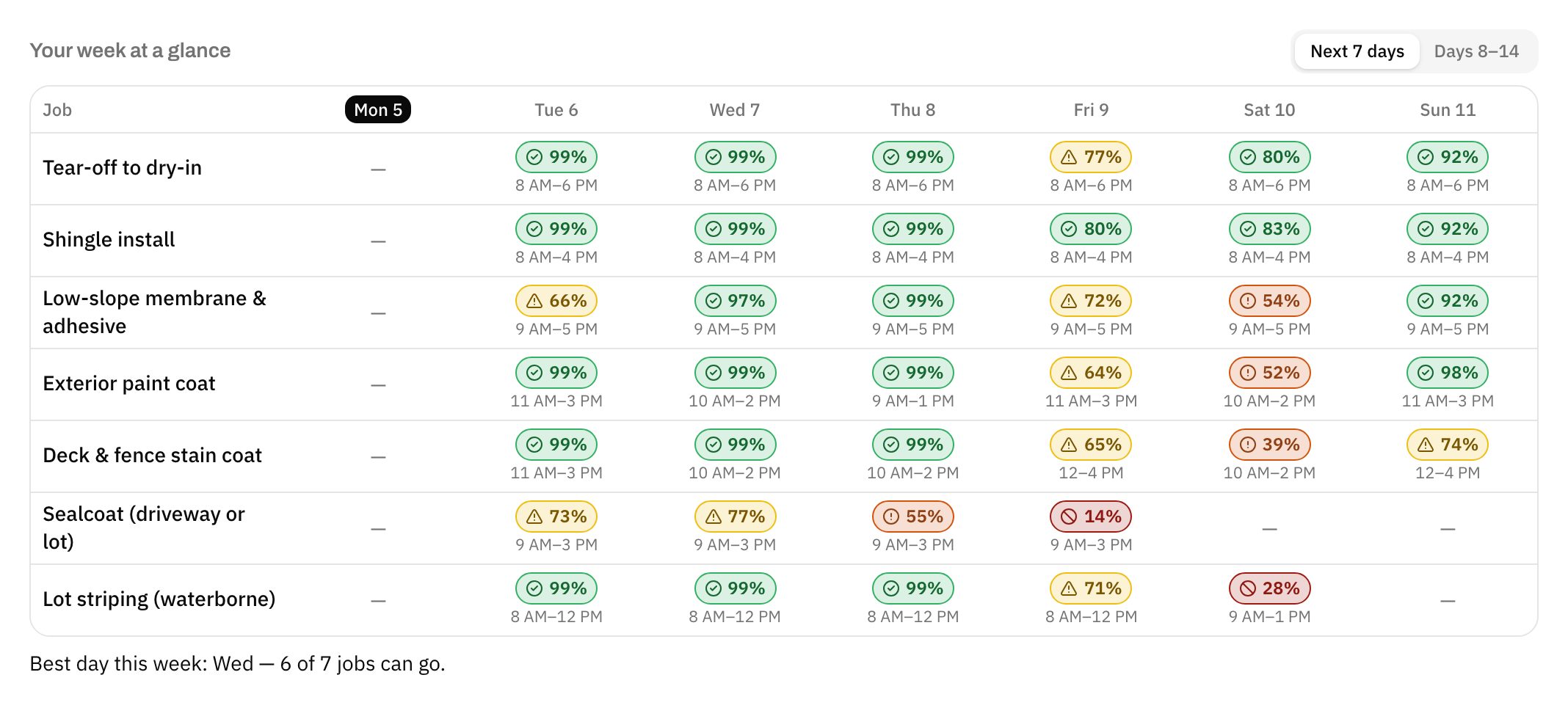
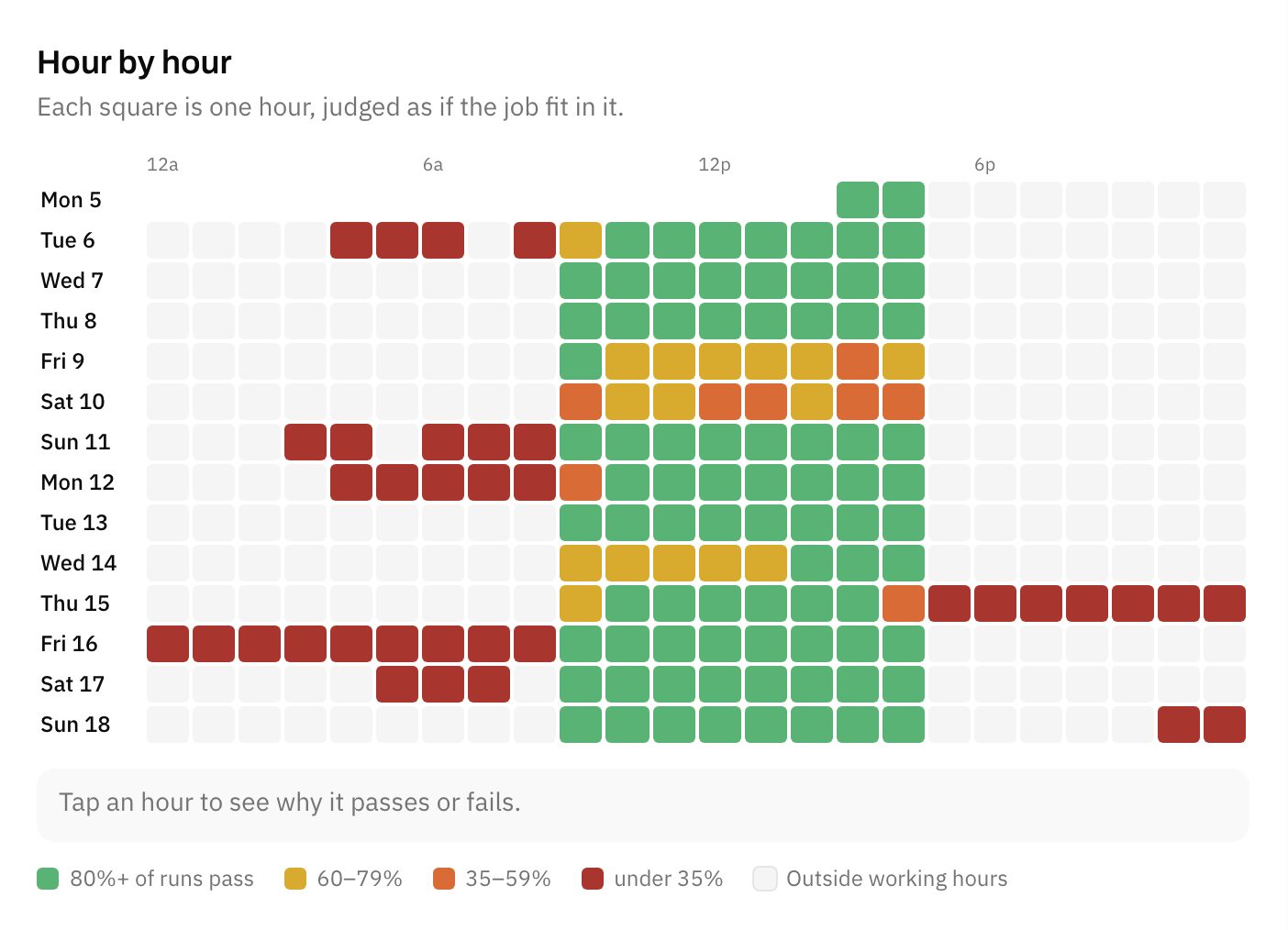
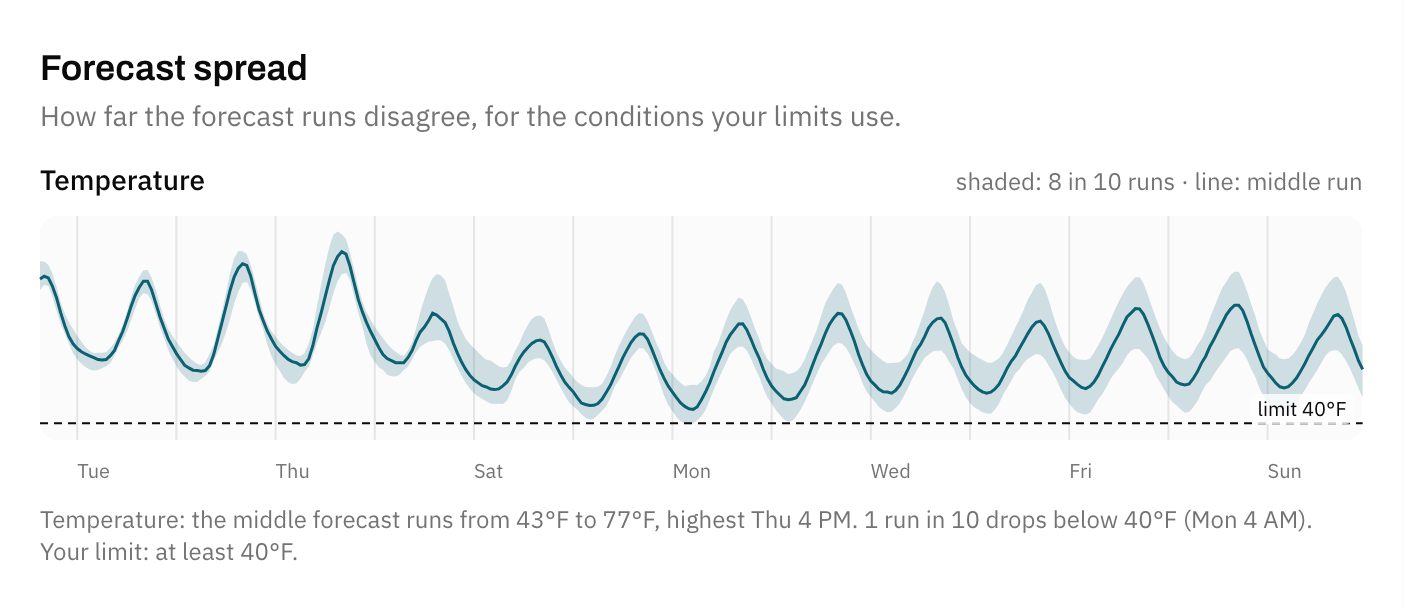
Real forecasts for Portland, Willamette Valley, Oregon, captured October 5, 2026. Yours will be for your own place and limits.
What you get
Built for roofing, exterior painting, siding and sealcoating/striping contractors
Dry-in window
The morning to start a tear-off, with the odds you finish dried in before rain, set to your crew's tear-off-to-dry-in time.
Dew and cure
Your paint start time against evening dew on the wall, using an estimated surface temperature and your product's minimum.
Seal-strip activation
Whether the shingles you lay get enough sun and warmth to seal in three days, or whether to hand-seal.
Sealcoat 24-hour check
50 °F and rising, holding 50 °F for the next 24 hours, with no rain on the fresh sealcoat.
Striping 24-hour hold
Striping a dry lot with waterborne paint, with the air staying at 45 °F or above for 24 hours after.
Low-slope membrane dew check
Adhered TPO, PVC or EPDM days that stay clear of dew and dry long enough for the adhesive.
The jobs it times
Tear-off to dry-in
Strip the old roof and get underlayment on before any rain: your 8 h tear-off-to-dry-in time plus 2 h to spare.
10-hour window · daylight only
Shingle install
Lay asphalt shingles that will self-seal. At 40 °F or colder, hand-seal with roof cement.
8-hour window · daylight only
Low-slope membrane & adhesive
Fully adhered TPO, PVC or EPDM. Set the temperature from your adhesive's data sheet.
8-hour window · daylight only
Exterior paint coat
One coat of exterior acrylic, kept above your product's minimum and clear of dew, with no rain until it is rain-safe.
4-hour window · daylight only
Deck & fence stain coat
One coat of stain on dry wood, with half a day to dry before rain. Use the temperature on the can.
4-hour window · daylight only
Sealcoat (driveway or lot)
Sealcoat a driveway or lot at 50 °F and rising, holding 50 °F and staying dry for the next 24 hours.
6-hour window · daylight only
Lot striping (waterborne)
Striping a dry lot with waterborne paint at 45 °F or warmer, staying at 45 °F or above for 24 hours.
4-hour window · daylight only
What else it watches
- Dry-in window
- Dew and cure
- Seal-strip activation
- Rain on the job, last 3 days
- Two dry days (for sealcoat and stain)
- Frost on the deck tonight
Every answer counts the forecast runs that keep the whole job inside your limits, at your job.
Founding members
Join the beta — your first six months free
Only 10 founding places: the first 10 roofing, exterior painting, siding and sealcoating/striping contractors to apply get the Roofing & Exteriors edition free for six months when it launches. No card needed. When they're gone, it's the waitlist.
Only 10 founding places.
- Your first six months of the Roofing & Exteriors edition free when it launches
- Early access to the app as it is today
- A say in which jobs the Roofing & Exteriors edition times next
Questions
Asked before you start
How is this different from a weather app?
A weather app says "40% chance of rain". This checks every hour your job needs, plus the hours after, in each of up to 146 forecast runs, and tells you how many keep the job dry.
Can I show it to a homeowner or keep a job record?
Yes. Show them the job card, or log a window: the decision log keeps the verdict, the share of forecast runs that passed and the conditions the forecast showed, with your note, and exports to CSV.
Does it know my roof or wall temperature?
No forecast does. We estimate it from air temperature, sun and wind and label it as an estimate. Shade, colour and roof pitch can move the real surface a lot.
What data does it use?
Forecasts for your job's grid cell: an hourly forecast plus up to 146 forecast runs from three independent forecast systems, pooled and judged run by run, 14 days ahead and refreshed through the day.
Whose limits are built in?
Owens Corning, Sherwin-Williams, SealMaster and CDOT where they publish numbers; the rest are marked starting points. Your product's label always wins. The Sherwin-Williams 35 °F, 5 °F above the dew point and 2–3 h rain-free times are per research notes, unverified: we could not read the data sheets themselves. Membrane adhesive temperature, stain limits, shingle wind and tear-off limits have no published number we found; they are starting points.
What can't it tell me?
Dew on the surface is inferred from the forecast dew point and the surface estimate; there is no wetness sensor. There is no radar or lightning, so a pop-up storm over the job is not something we can call an hour out. Gusts are forecast at 10 m, not at the ridge or on a three-storey wall. Caulk and siding work have no job type of their own.