For highway, site-prep, paving and utility contractors
Know which days your spread will run.
Paving, dirt, pipe, striping and pours checked against your spec for every job, with odds from up to 146 forecast runs rather than one guess.
The costly call
A rained-out day still carries the job's overhead
When the spread can't run, the trailer, the equipment and the super are still on the clock, and on a delay that overhead is priced per day. Calling the crew out to a day that washes out, or sending them home from one that would have held, costs you either way.
$2,407.27 per day
extended general conditions in one reported delay case (Clark Construction, 2004)
How it works
From your place to an answer
Drop a pin on the job
Any job in the US: a highway segment, a site, a pipeline crossing.
Set your spec
Lift thickness, striping paint, crane limit and when your working day starts. Every limit is yours to change.
Call the crew the night before
Read which days each operation runs and the odds that it holds, then make the call.
In the app
See it on a real forecast
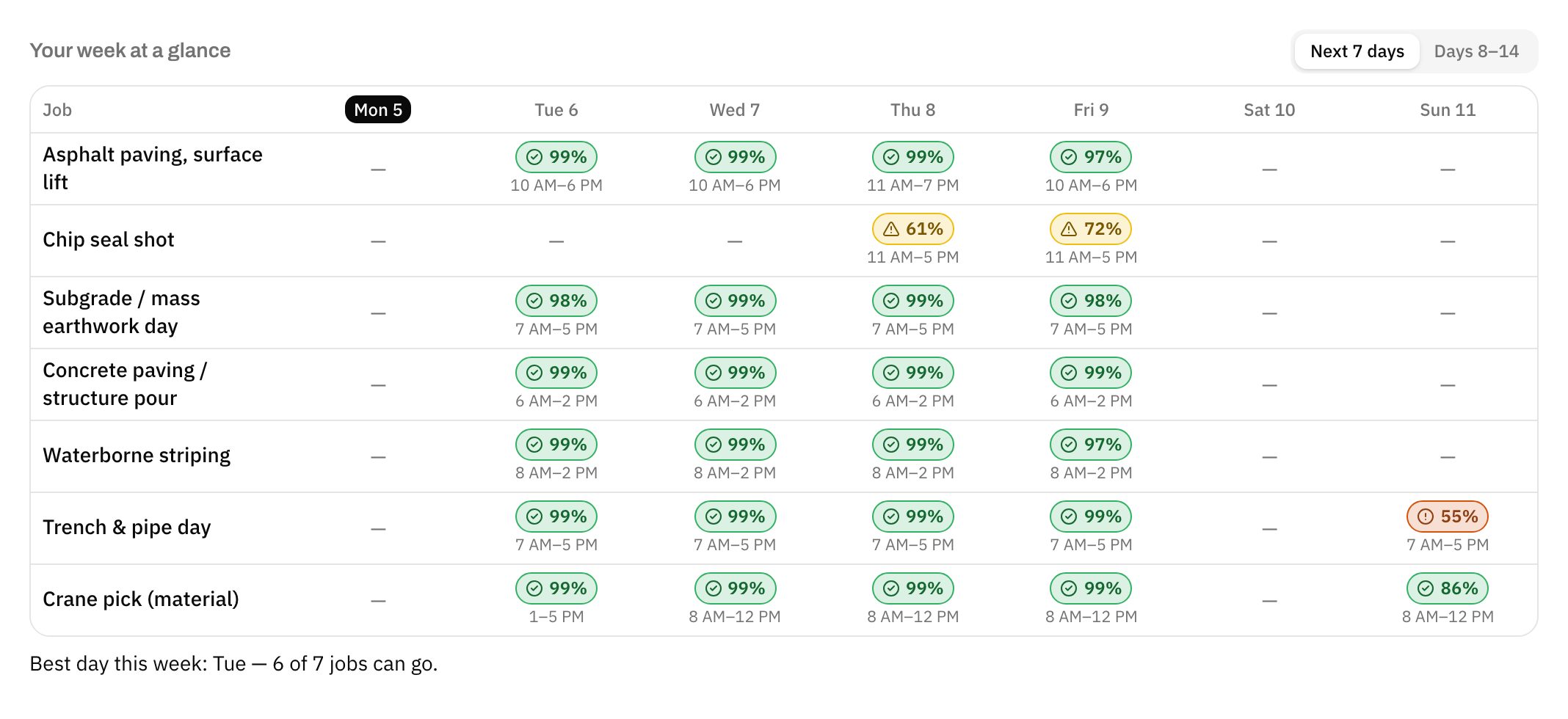
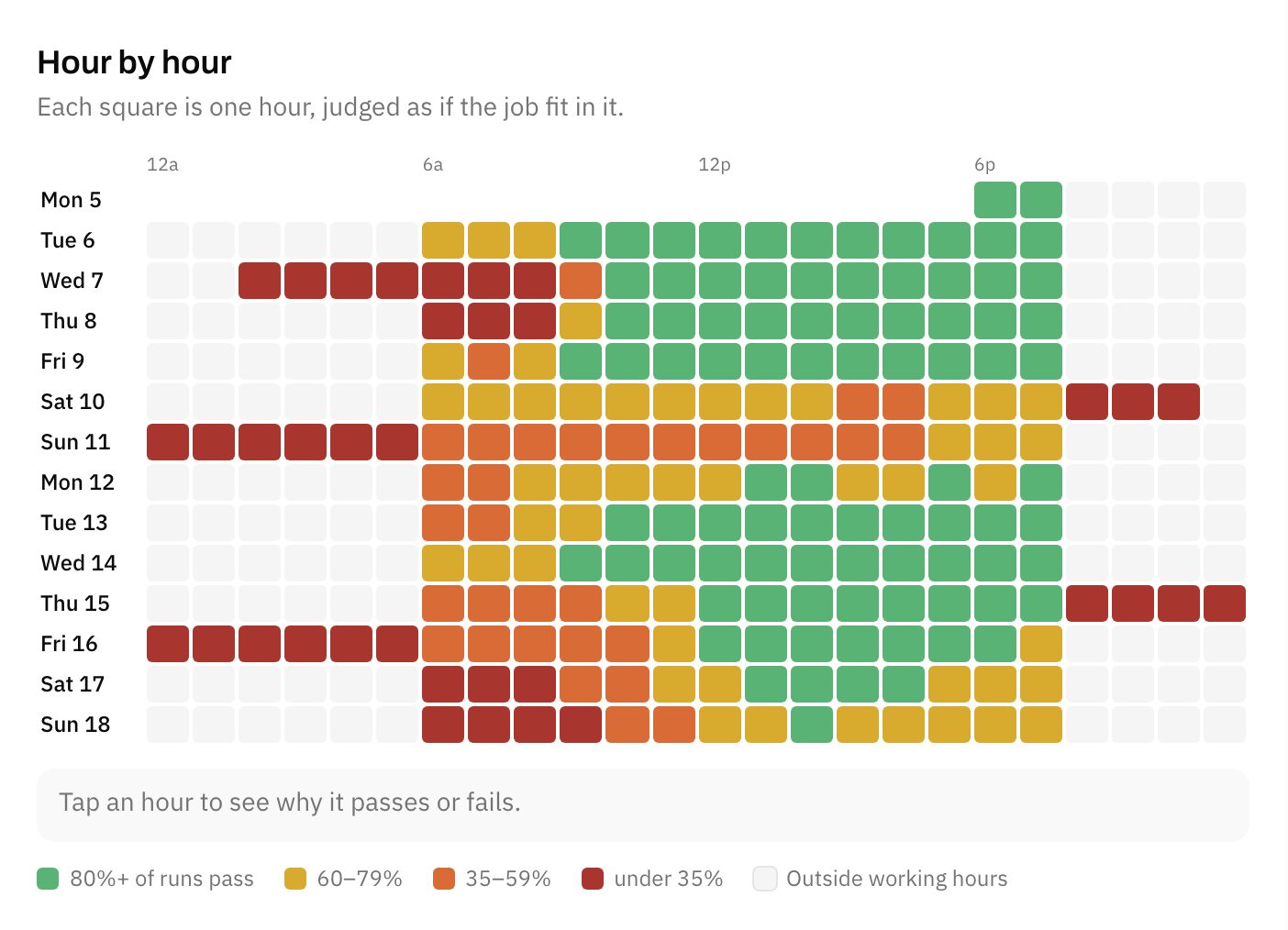
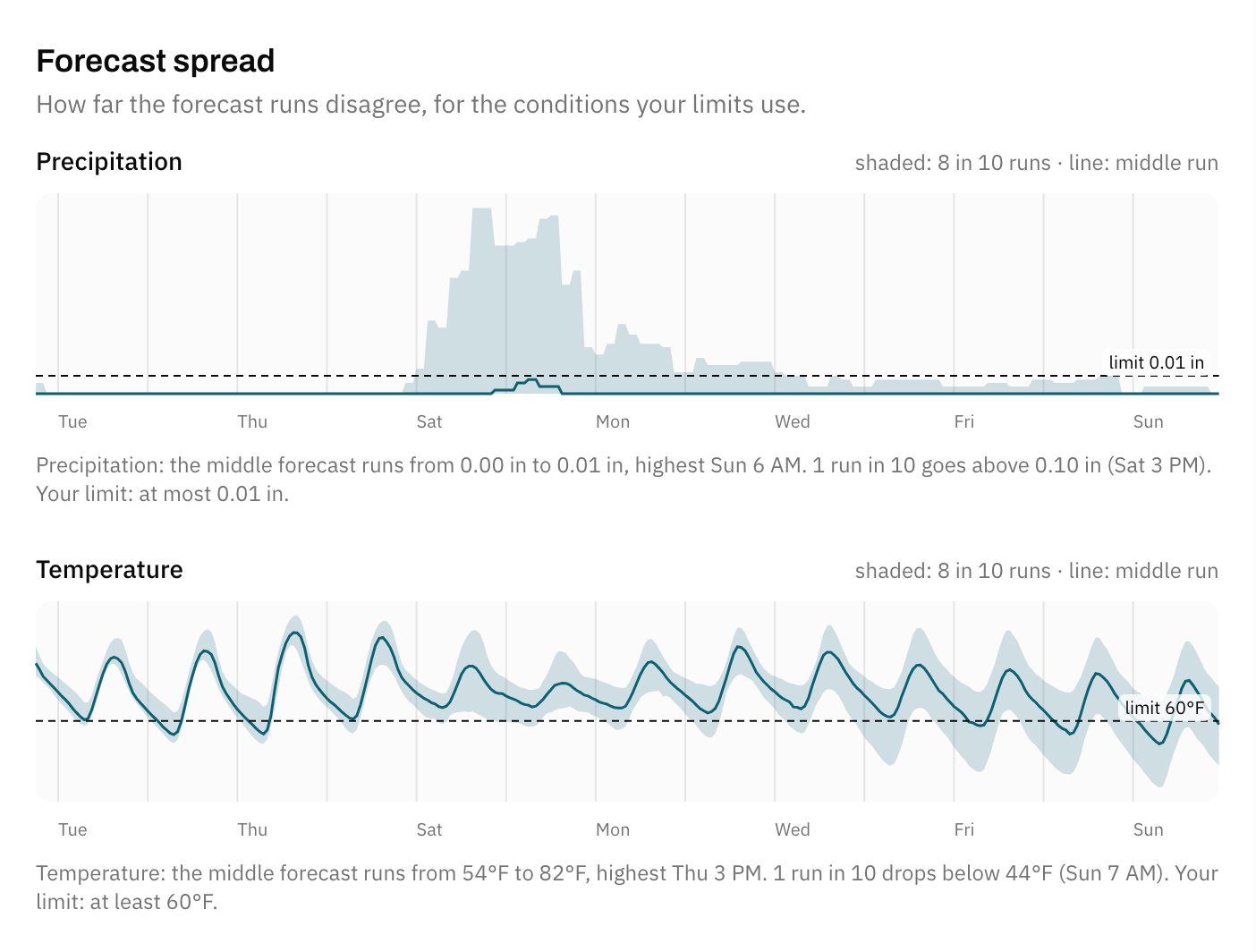
Real forecasts for Atlanta, North Georgia, captured October 5, 2026. Yours will be for your own place and limits.
What you get
Built for highway, site-prep, paving and utility contractors
Paving window
Hours in a row at your spec's air temperature for the lift you're laying, with an estimated surface temperature shown and labelled as an estimate.
Workable ground
Dry-back after the last soaking rain plus tomorrow's odds of a dry working day, so you know whether to haul dirt or park the scrapers.
Lost-day outlook
The next 10 working days by the 0.1 in rule, with sustained wind and a recovery day after an inch of rain counted in.
Chip seal and striping checks
Air temperature at spec through the shot or the lines, a dry surface, and the 24-hour hold for waterborne paint.
Concrete pour with three-day cold check
Slipform or deck pours checked for evaporation, rain and air staying at 40 °F or above for 72 hours after.
Crane pick wind at boom height
Wind at 80 m against your crane's limit for every pick window, for planning ahead of the on-site reading.
The operations it times
Asphalt paving, surface lift
Lay a top lift under 1½ in where the spec says air and surface must both be at or above 60 °F. Night paving allowed. Surface temperature is not forecast; the paving window shows an estimated surface beside this check.
8-hour window
Chip seal shot
Shoot emulsion and spread cover coat on a dry surface at 70 °F or warmer, with no rain for 12 hours after the shot.
6-hour window · daylight only
Subgrade / mass earthwork day
Cut, fill and compact without making mud: a dry working day after a dry day before, on ground the model does not show as saturated.
10-hour window
Concrete paving / structure pour
Slipform paving, bridge deck, wall or footing pour, with a check that air stays at 40 °F or above for the three days after.
8-hour window
Waterborne striping
Long-line or skip lines with high-build waterborne paint on dry pavement, with air at 45 °F or above and staying there for 24 hours.
6-hour window · daylight only
Trench & pipe day
Open trench, lay and backfill pipe. OSHA 29 CFR 1926.651(k)(1) requires a competent-person inspection after every rainstorm and 1926.651(h) bars work in accumulating water; OSHA gives no rainfall number, so these limits are yours.
10-hour window
Crane pick (material)
Set girders, boxes and structure. Wind at boom height is sustained only. If workers ride a platform, OSHA 1926.1431(k)(8)(i) requires a qualified-person determination when wind or gusts exceed 20 mph.
4-hour window · daylight only
What else it watches
- Paving window
- Workable ground
- Lost-day outlook
- Rain on the job, last 7 days
- Three dry working days in a row
- Wind at boom height
- Freeze on fresh work
Every answer counts the forecast runs that keep the whole operation inside your limits, at your job.
Founding members
Join the beta — your first six months free
Only 10 founding places: the first 10 highway, site-prep, paving and utility contractors to apply get the Heavy Civil & Earthwork edition free for six months when it launches. No card needed. When they're gone, it's the waitlist.
Only 10 founding places.
- Your first six months of the Heavy Civil & Earthwork edition free when it launches
- Early access to the app as it is today
- A say in which operations the Heavy Civil & Earthwork edition times next
Questions
Asked before you start
How is this different from a weather app?
A weather app gives one forecast and a rain percentage. This checks every hour of your operation against your spec in each of up to 146 forecast runs and tells you how many runs pass.
Can I keep a record of my weather calls?
Yes. Log a window and the decision log keeps the verdict, the share of forecast runs that passed and the conditions the forecast showed, with your note. Export it to CSV whenever you need it.
Does it know pavement temperature?
No forecast does. We show a labelled estimate from air temperature, sunshine and wind; the inspector's reading wins.
What data does it use?
Forecasts for your job's grid cell: an hourly forecast plus up to 146 forecast runs from three independent forecast systems, pooled and judged run by run, 14 days ahead and refreshed through the day.
Whose spec is built in?
Defaults cite CDOT 2023 Standard Specifications and ACI; change any limit to your state's spec.
What can't it see?
Your site. Drainage, clay, haul roads and pumps decide workability more than any grid cell, and soil moisture is model output for the top few inches. Gusts at hook height are not in the forecast runs, so crane checks are for planning. No lightning or radar: it cannot call a storm cell over your job an hour out.