For commercial snow and ice management contractors
Know if it's a push before you call crews.
Chance of a 1, 2, 4 or 8-inch event at each site, the brine window before it, and the refreeze watch after, from up to 146 forecast runs.
The costly call
Call crews at the wrong hour and it costs you
Call crews too early and you pay for idle hours; too late and lots are packed before the first pass. Brine laid ahead of rain washes off.
How it works
From your place to an answer
Add your sites
Add each lot or site you service.
Set your contract triggers and lead time
Your contract trigger depth, snow ratio and how long crews need from the call to the lot.
See the call
The chance of a push, the onset window, when to call in, when to pre-treat and whether it refreezes.
In the app
See it on a real forecast
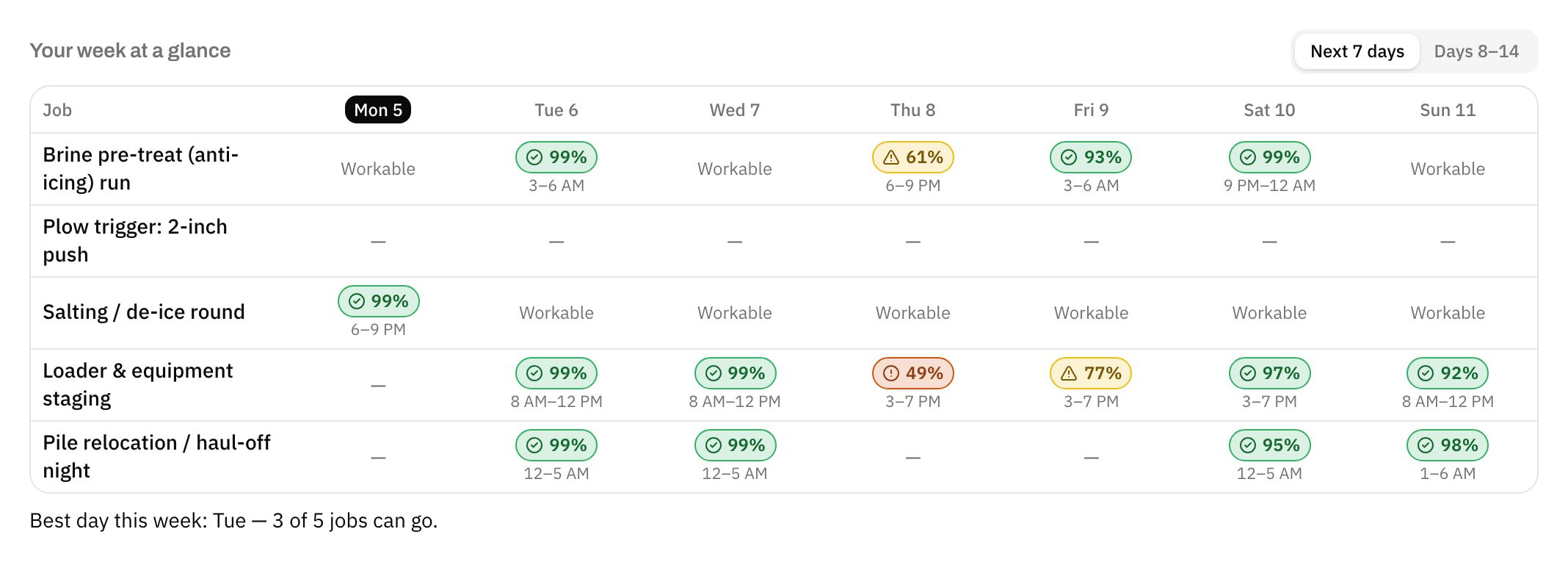
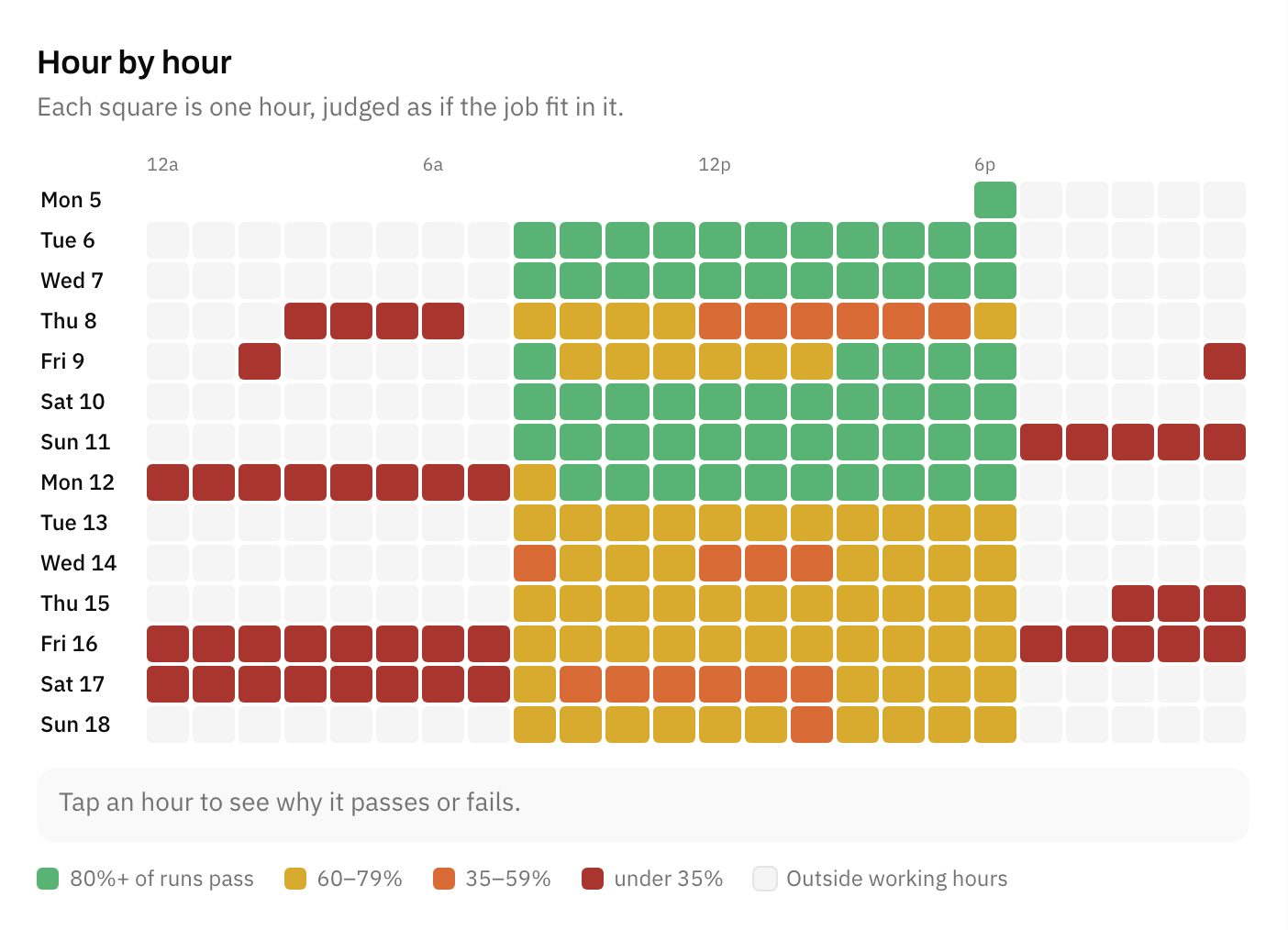
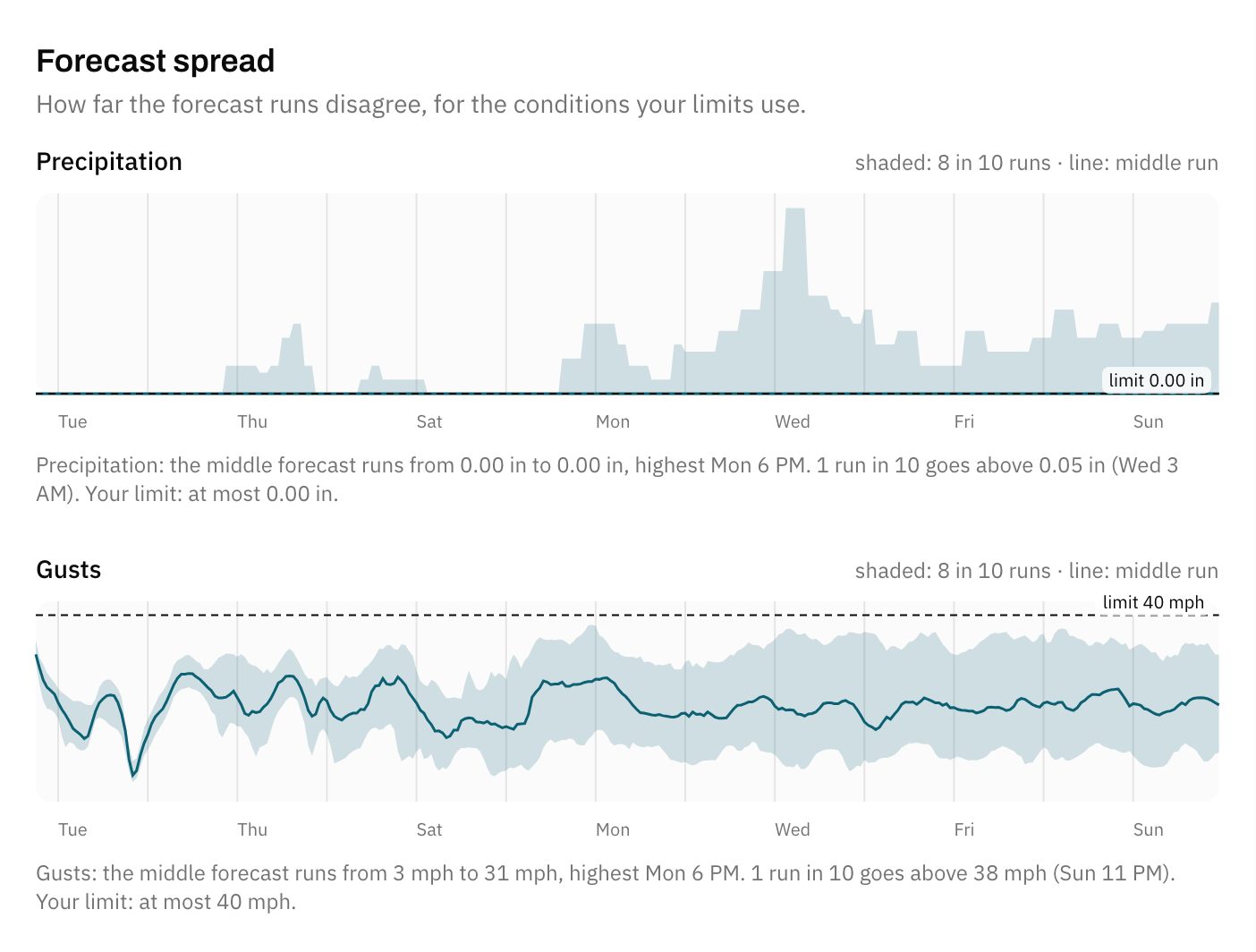
Real forecasts for Syracuse, NY, Lake Ontario snow belt, captured October 5, 2026. Yours will be for your own place and limits.
What you get
Built for commercial snow and ice management contractors
Event outlook
Onset window and the chance of 1, 2, 4 and 8 inches or more of estimated snow (10:1) at each site.
Crew call-in time
Built from the earliest likely onset and your lead time.
Pre-treat window
Dry hours at 23 °F or warmer before onset, with no rain to wash the brine off. Air temp, not pavement.
Refreeze watch
Melt or rain followed by a freeze, night by night.
Salt-run check
Light snow and air temperature of 15 °F or warmer.
Staging and haul-off windows
Daylight windows to trailer loaders to sites, and overnight windows to push back or haul piles.
The services it times
Brine pre-treat (anti-icing) run
Liquid anti-icing route laid on dry pavement ahead of an event. Air temp, not pavement: bridges, parking decks and shaded lots run colder. Shows when pavement and air allow a run, not whether one is needed — see Pre-treat window.
3-hour window
Plow trigger: 2-inch push
Snow falling hard enough at your site to reach a 2-inch trigger in four hours (estimated snow (10:1)). Counts only steady, heavy snow; slow build-ups show in the event outlook. Trigger after Evergreen Plowing's per-push tiers (plowable events 2+ inches); set your own.
4-hour window
Salting / de-ice round
Salt or treated-salt route during light snow (under 0.5 in per hour of estimated snow (10:1)) or after the push. Air temp, not pavement.
3-hour window
Loader & equipment staging
Trailering loaders, skid steers and pushers to sites ahead of the event.
4-hour window · daylight only
Pile relocation / haul-off night
Pushing back or hauling stacked piles while lots are empty.
5-hour window
What else it watches
- Event outlook & crew call-in
- Pre-treat window
- Refreeze watch
- Freezing hours at your site
- Drifting wind
Every answer counts the forecast runs that keep the whole service inside your limits, at your site.
Founding members
Join the beta — your first six months free
Only 10 founding places: the first 10 commercial snow and ice management contractors to apply get the Snow & Ice edition free for six months when it launches. No card needed. When they're gone, it's the waitlist.
Only 10 founding places.
- Your first six months of the Snow & Ice edition free when it launches
- Early access to the app as it is today
- A say in which services the Snow & Ice edition times next
Questions
Asked before you start
How is this different from a weather app?
A weather app gives one snowfall number. This runs your trigger against every forecast run and tells you the share that reach it, when it starts and whether it's snow at all.
Can I keep a service log of my calls?
Yes. Log a window and the decision log keeps the verdict, the share of forecast runs that passed and the conditions the forecast showed, with your note. Snow amounts are shown as estimated snow (10:1). Export it to CSV whenever you need it.
Where does the snow number come from?
It is an estimate: each run's precipitation × 10 when that run's air is at or below 32 °F, shown as estimated snow (10:1). You can change both numbers.
Does it know pavement temperature?
No. It uses air temperature and says so: air temp, not pavement. Lots, decks and bridges can be colder.
What data does it use?
It pools up to 146 forecast runs for your site from three independent forecast systems, judged run by run and refreshed through the day.