For wine-grape, almond, pistachio and walnut growers and their PCAs
Your next pass, block by block, with odds.
Sulfur windows under the heat cap, the mildew index, frost by bud stage, bee-flight hours, hull split and harvest rain. Each one has the share of up to 146 forecast runs that agree.
The costly call
Bees by the colony, sprays on a mildew clock
You pay for bees by the colony and spray on a mildew clock. A missed frost night or a rain on nuts on the ground costs a year's crop.
$209 per colony
Almond pollination fee 2025, Regions 6 & 7
How it works
From your place to an answer
Add your blocks
Add your blocks and set the crop and frost stage for each: almond bloom or petal fall, grape new growth, or your own critical temperature.
Pick the pass
Sulfur, oil, frost night, bloom spray, hull split, shake or pick, canopy crew.
See the window
See the next window, how sure it is and what is holding it back: wind, heat, rain or frost.
In the app
See it on a real forecast
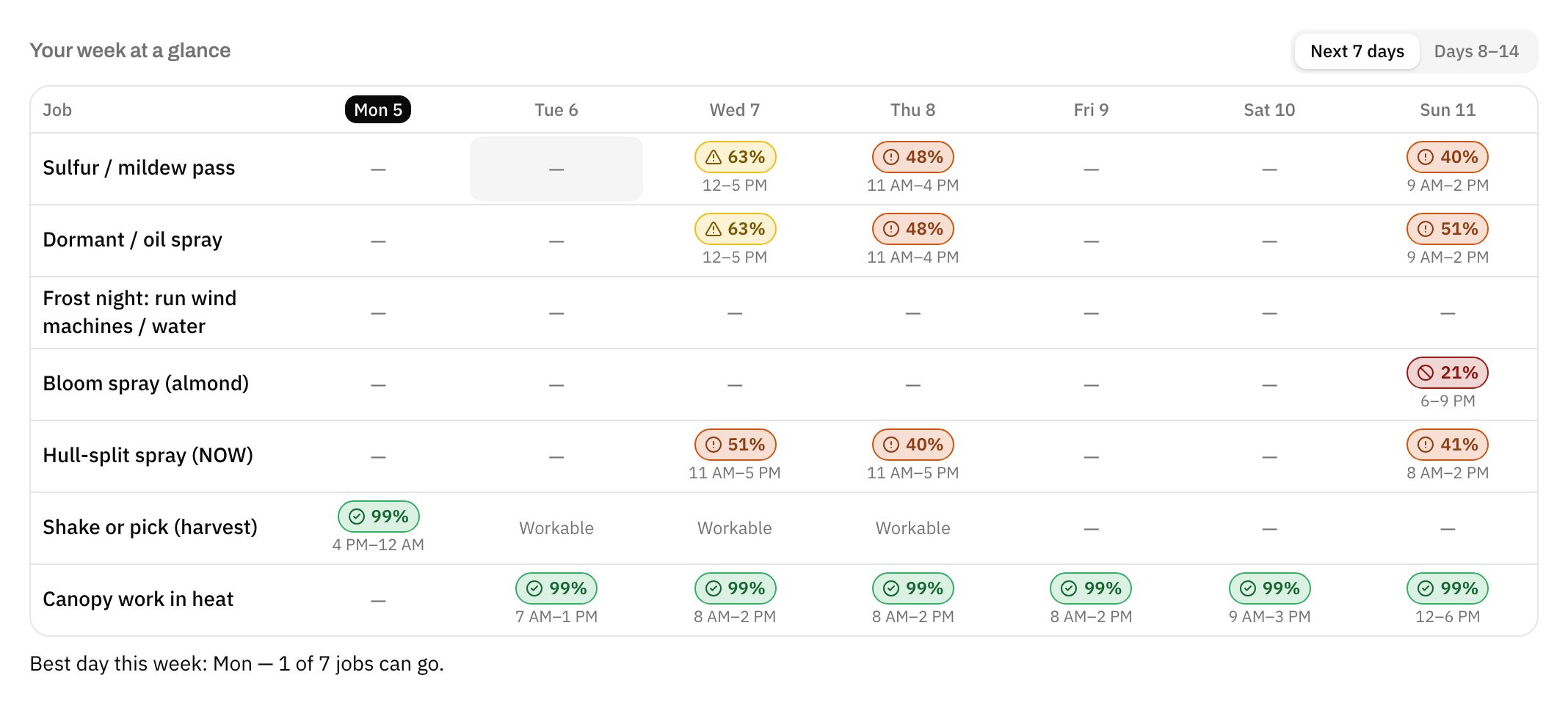
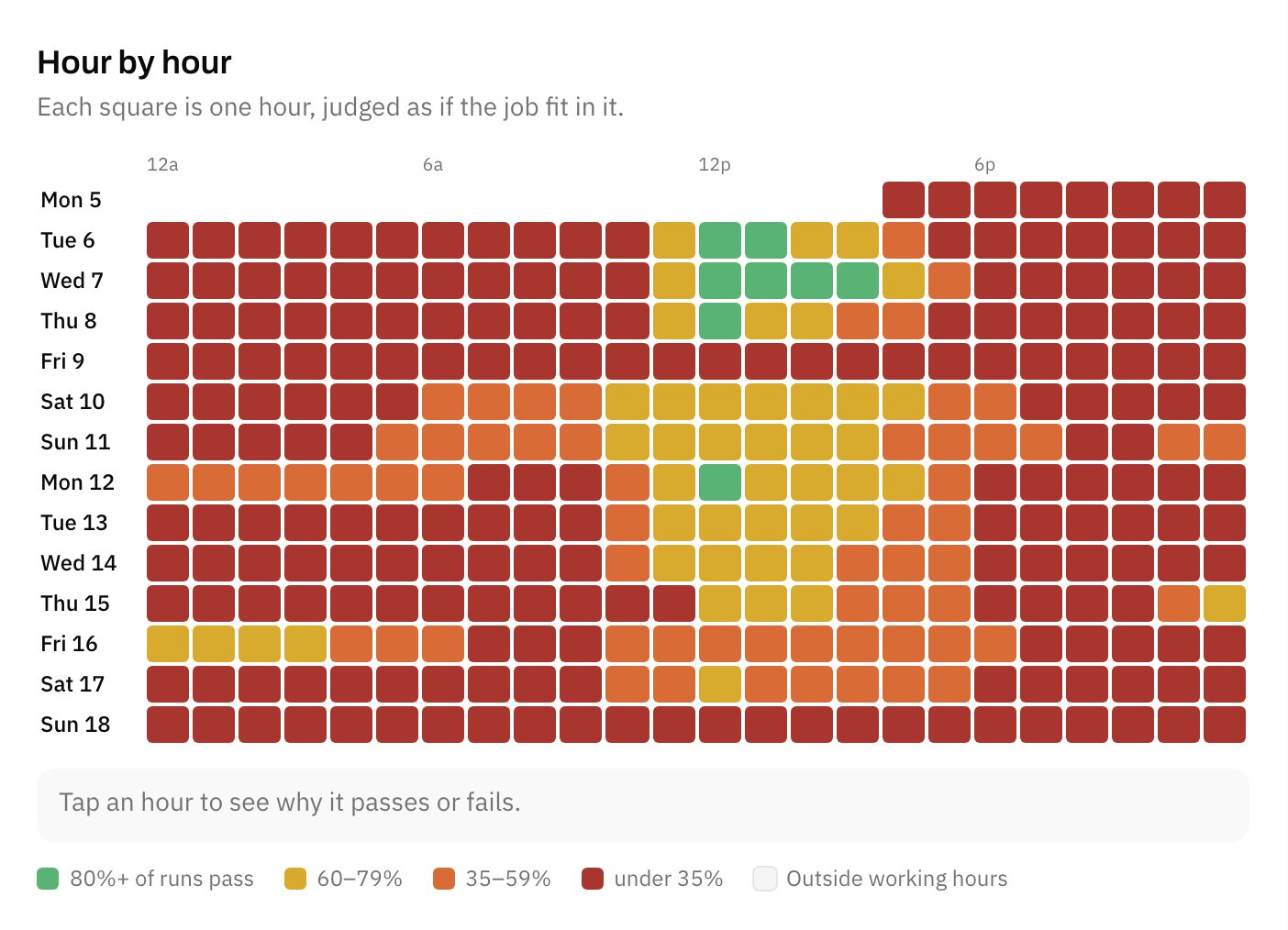
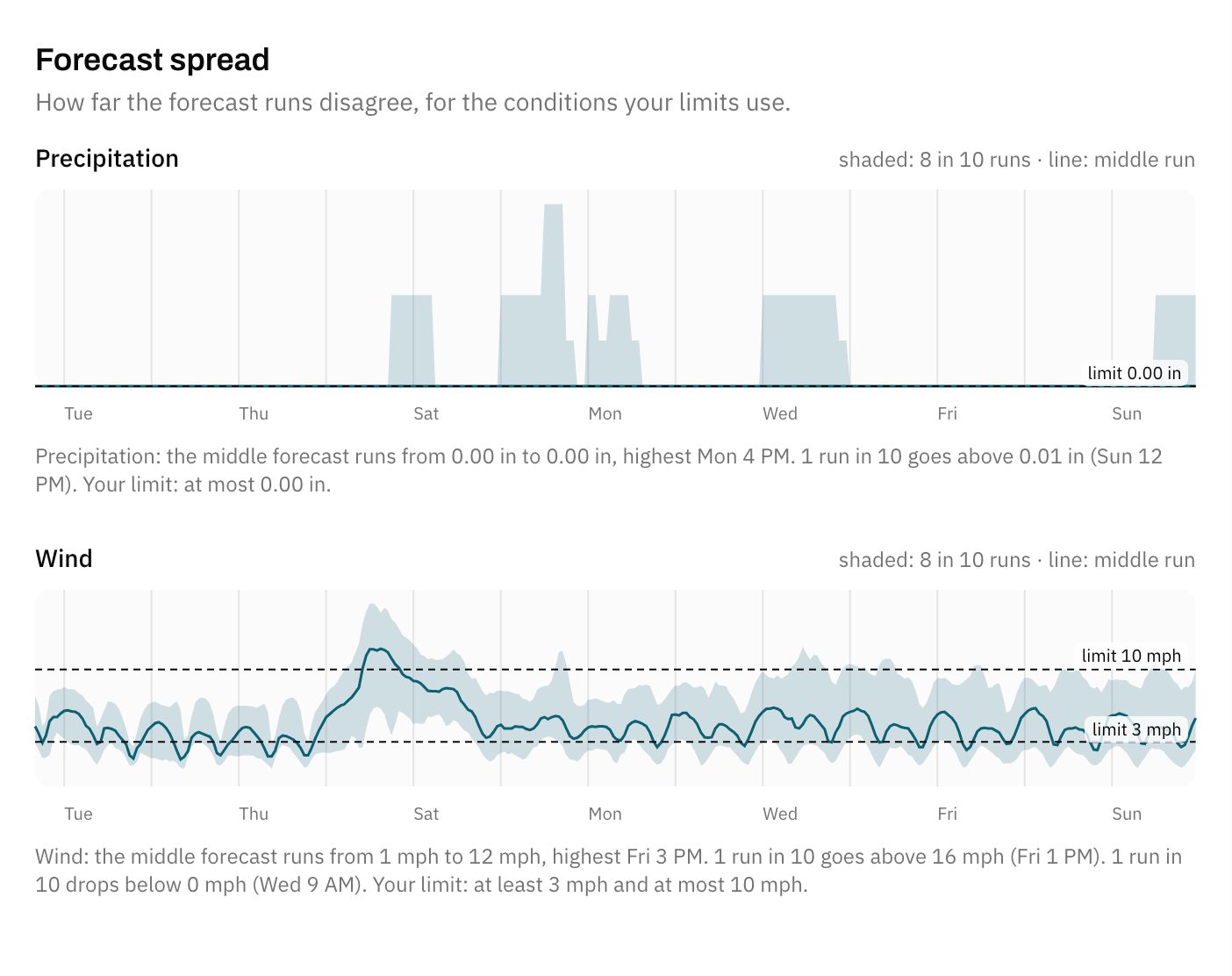
Real forecasts for Walla Walla, WA, Walla Walla Valley, captured October 5, 2026. Yours will be for your own place and limits.
What you get
Built for wine-grape, almond, pistachio and walnut growers and their PCAs
Powdery mildew index
The Gubler-Thomas index now and 7 days out, with the spray-interval band it puts you in.
Sulfur under the burn limit
A sulfur pass that keeps the 100 °F burn limit through the next day, inside the label's 3–10 mph wind band.
Frost by stage
The chance of reaching your bloom or nut-set critical temperature each night, and the nights wind machines can work.
Bee-flight hours
How many hours each bloom day are warm, calm and dry enough for the bees you rented to work.
Navel orangeworm degree days
Degree days from your biofix toward hull split, with the UC IPM generation targets.
Shake or pick
The rain chance for the days nuts lie on the ground, or before ripe clusters come in.
The passes it times
Sulfur / mildew pass
Powdery mildew cover spray (sulfur or a synthetic). Sulfur burns leaves and fruit in heat, so the pass also needs the next 24 h at or under 100 °F. Never mix oil and sulfur or apply one within 2 weeks of the other (UC IPM). The app does not know your last oil or sulfur pass, so check your spray log.
5-hour window
Dormant / oil spray
Dormant oil, alone or with an insecticide, on almonds, walnuts, pistachios or vines in winter. No freeze for 24 h while oil is on the wood. Never mix oil and sulfur or apply one within 2 weeks of the other (UC IPM). The app does not know your last oil or sulfur pass, so check your spray log.
5-hour window · daylight only
Frost night: run wind machines / water
A window here means protection is needed and wind machines can work: cold enough to protect, calm, with warmer air aloft for the fan to pull down. It is not good weather. Set the trigger a few degrees above your stage's critical temperature.
3-hour window
Bloom spray (almond)
Bloom fungicide pass timed outside the hours bees are working: late afternoon and evening, 4 pm to 10 pm. Set the hours from your county rules and beekeeper agreement.
3-hour window
Hull-split spray (NOW)
Navel orangeworm pass at the start of hull split; UC IPM says no later than 1% hull split when eggs are being laid. Time it with the navel orangeworm degree days and your own hull-split scouting.
6-hour window · daylight only
Shake or pick (harvest)
Shaking nuts to dry on the orchard floor, or picking grapes. Rain on nuts on the ground or on ripe clusters costs quality, so it needs 3 dry days after. For grapes, shorten that.
8-hour window
Canopy work in heat
Hand crews leafing, shoot thinning, suckering or pruning; heat sets the cut-off time. Check Cal/OSHA Heat Illness Prevention (Title 8 §3395) for the triggers that apply to you.
6-hour window · daylight only
What else it watches
- Powdery mildew index
- Navel orangeworm degree days
- Frost by stage
- Bee-flight hours
- Crew heat
- Rain on the block, last and next 7 days
- Dry days for nuts on the ground
Every answer counts the forecast runs that keep the whole pass inside your limits, at your block.
Founding members
Join the beta — your first six months free
Only 10 founding places: the first 10 wine-grape, almond, pistachio and walnut growers and their PCAs to apply get the Vineyards & Nut Orchards edition free for six months when it launches. No card needed. When they're gone, it's the waitlist.
Only 10 founding places.
- Your first six months of the Vineyards & Nut Orchards edition free when it launches
- Early access to the app as it is today
- A say in which passes the Vineyards & Nut Orchards edition times next
Questions
Asked before you start
How is this different from a weather app?
A weather app gives one forecast. We check each hour against your pass's limits in up to 146 separate forecast runs, then show the share of runs where the whole pass fits.
Can I keep a record of my passes?
Yes. Log a window and the decision log keeps the verdict, the share of forecast runs that passed and the conditions the forecast showed, with your note. Export it to CSV whenever you need it.
What data does it use?
Hourly forecasts, up to 146 forecast runs from three independent forecast systems pooled and judged run by run, and season-to-date daily temperatures from 1 January, for your block's grid cell, refreshed through the day.
Does it replace my weather station?
No. It looks forward 14 days; a station tells you what happened in your block. Use both.
Where do the limits come from?
Each limit names its source: UC IPM, the FAO frost manual or a label. The ones without a source are marked as starting points, and you can edit them. The mildew index uses forecast air temperature, not canopy temperature, and only the last 14 days plus the forecast.